
HubRise User Guide
- home
- HubRise User Guide
- Apps and Connections
Apps and Connections
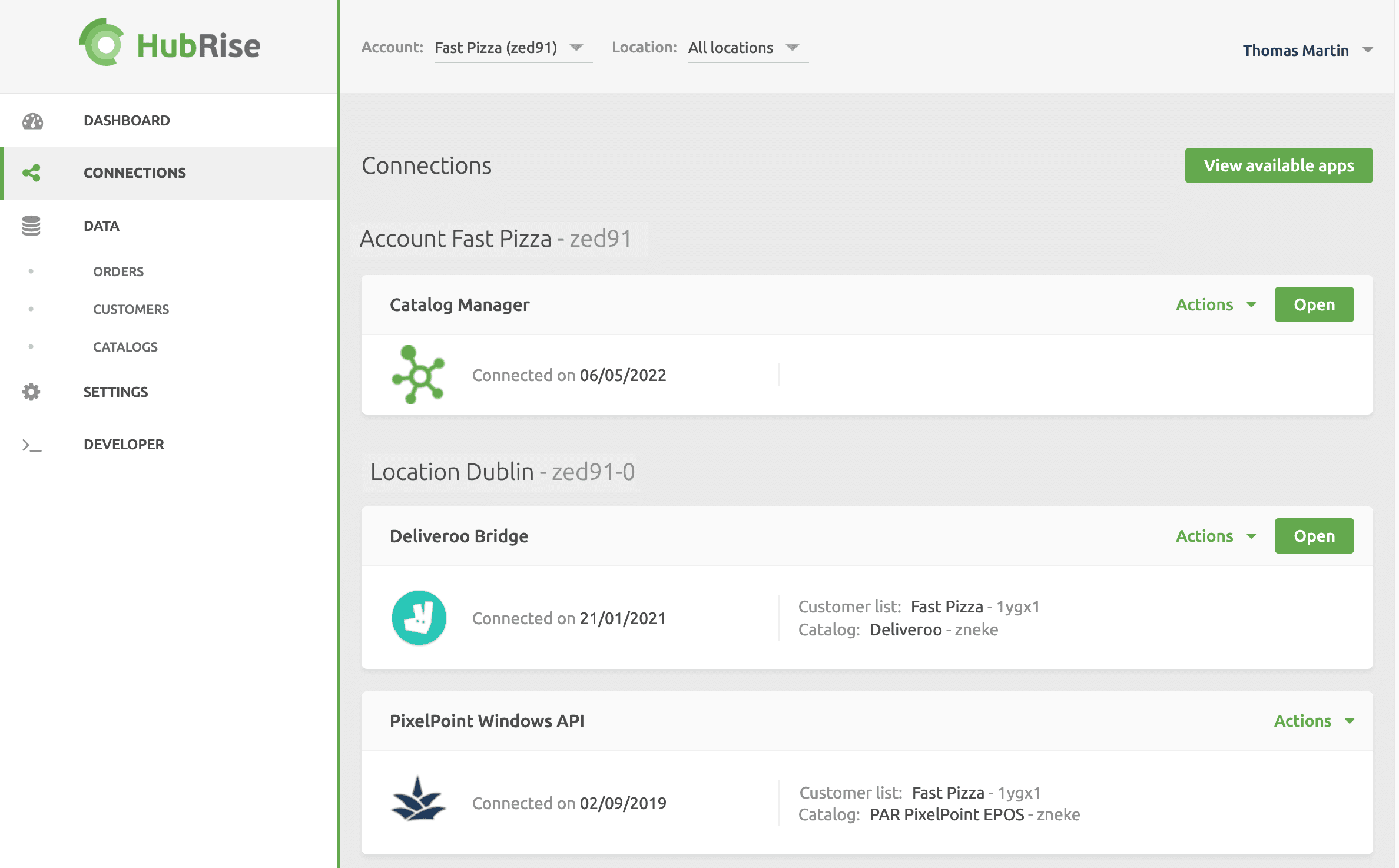
You can connect new apps and see apps connected to your HubRise Account from the CONNECTIONS page. From this page, you can also view apps activity and logs, and block or disconnect apps.
Available Apps
HubRise is used to connect an ever-growing ecosystem of solutions: EPOS, online ordering, food delivery platforms (including Deliveroo, Uber Eats and Just Eat), self ordering solutions, delivery management, delivery services, eMarketing (SMS/emailing), business intelligence, stock management, loyalty systems, and more. The number of compatible applications increases every month.
You can connect all apps available in the HubRise Apps page. If you cannot see an app you need to connect on this page, contact contact@hubrise.com to find out if an integration is planned.
Connect an App
Apps are connected to either a HubRise Account or Location. Connection level depends on the data shared with the app. For example, EPOS or online ordering systems typically connect to Locations, while catalog management solutions may connect to Accounts or Locations.
Some apps can be connected directly from the HubRise back office, while others require configuration from within the app before connection. For complete details, see the app documentation in the HubRise Apps page.
You can connect several instances of the same app to the same HubRise Account or Location; for example, you can connect multiple pages on food delivery platforms to a single Location. Additional fees may apply if you qualify as a Dark Kitchen, see our Pricing page.
To connect an app:
- Log in to HubRise from the HubRise Login page.
- Click CONNECTIONS on the left navigation panel.
- Select View available apps.
- Select the Location to connect if the app connects at the location level. You can also leave All locations selected: you will then be prompted to select the location in a later step.
- Select the app you want to install. If the app is not on this list, check the app documentation in the HubRise Apps page.
- Check instructions for the specific app and click Connect. The app will open in a new browser tab. If not, check your browser for ad-blockers, which might prevent the opening of a new window.
- If the app is already connected, the process creates a new connection, and you will need to provide a unique name to identify it.
- If the app requires access to a catalog or customer list, click Next, then select the resources to link. If you have only one catalog or customer list, it is selected by default.
- Grant the app access to your HubRise data by clicking Allow.
Open An App
Some apps can be accessed from HubRise. If so, you can open the app by clicking on CONNECTIONS and selecting Open for the specific app. The app will open in a new browser tab.
App contextual menu
For each app connected to HubRise, you can access a contextual menu by clicking on Actions. This menu allows you to:
- View logs: See all communications between the app and HubRise, and troubleshoot issues.
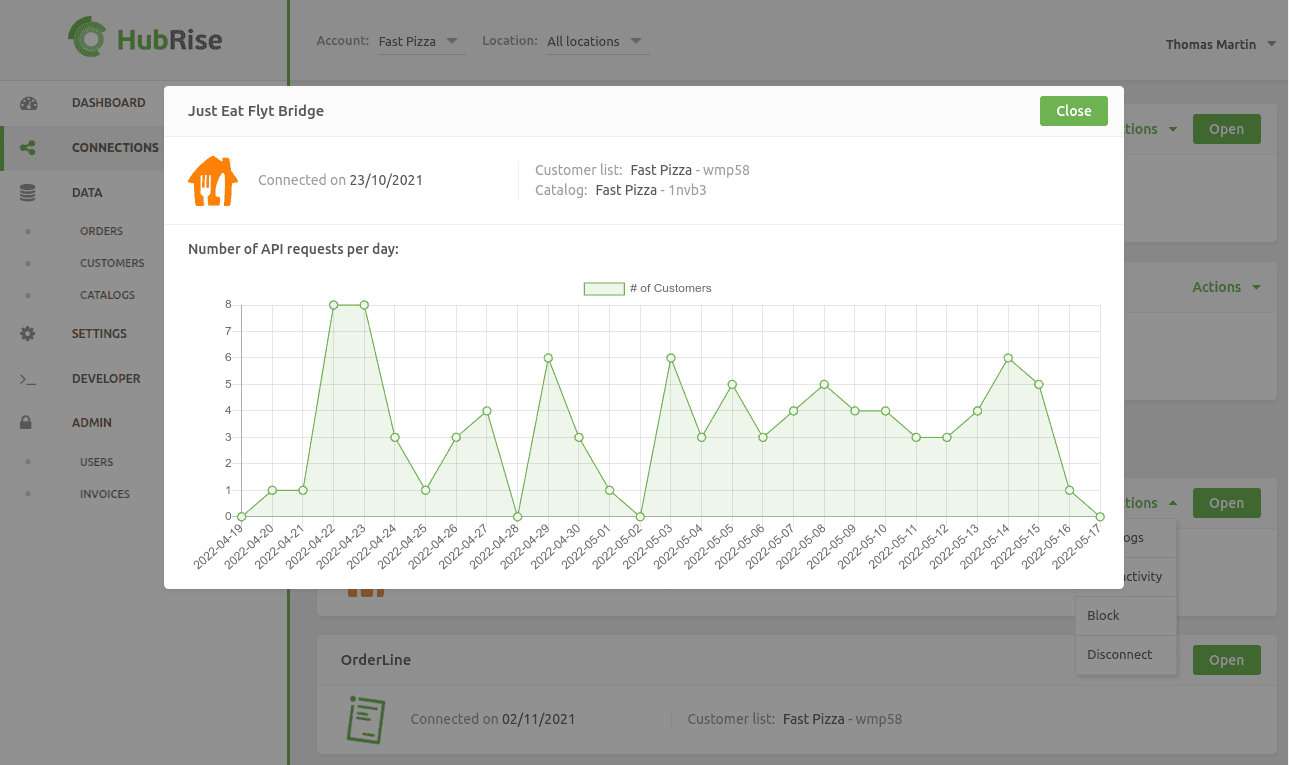
- View activity: Display a chart with the number of API transactions made in the last 30 days.
- Rename: Name each connection to help you identify it.
- Block / Unblock: Temporarily prevent an app from accessing HubRise.
- Disconnect: Permanently disconnect an app from HubRise.
- Reconnect the app: Switch the catalog or customer list linked to an app.
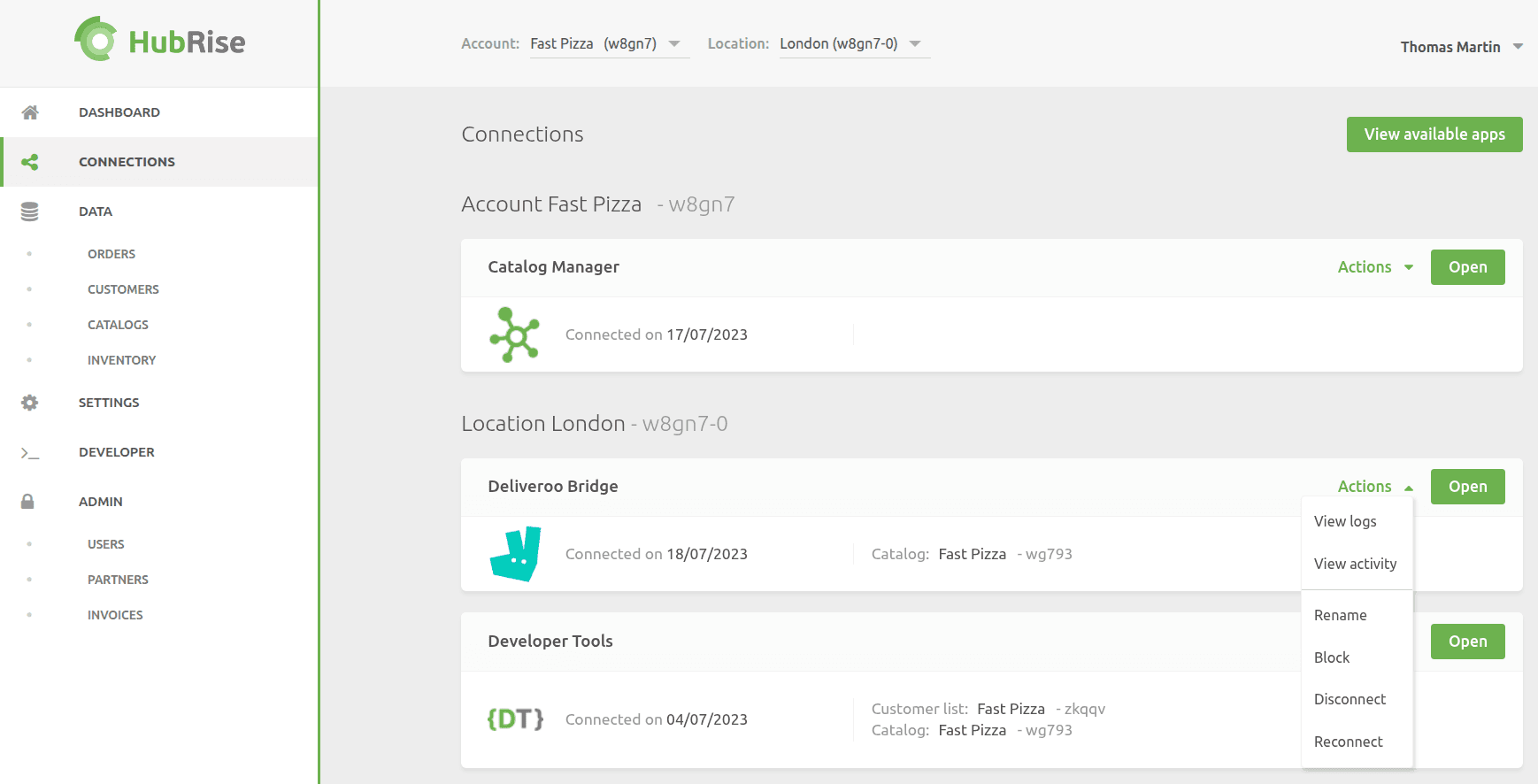
Some of these options are only available for certain apps. For example, the reconnect option is only available for apps with linked catalogs or customer lists.
View Connection Logs
Logs are stored for each app that has been connected. You can use logs to understand the communications between systems and detect issues.
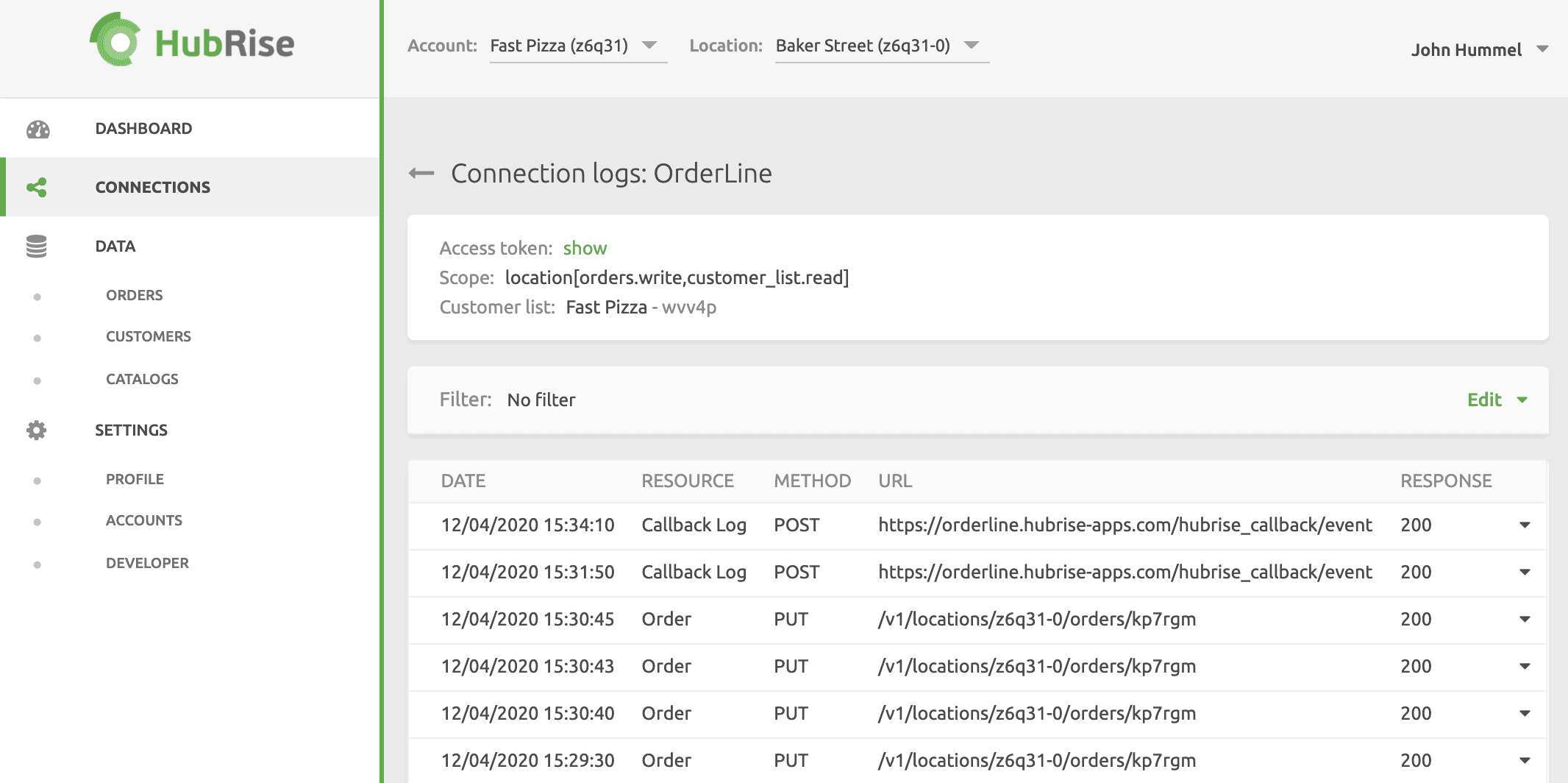
To view logs for a connection, select CONNECTIONS > Actions > View logs for the specific app.
Logs record the requests from an app to HubRise. Each request is a transaction between an app and HubRise, such as an order, a new customer registration, or any other communication between an app and HubRise.
General Information
At the top, the Connection logs page displays general information about the connection:
- Access token: The token used by the app to authenticate to HubRise.
- Scope: The connection permissions, such as whether the connection can access the Account or a single Location, what read/write access it has on the data, etc.
- Customer list and Catalog: Depending on the Scope, additional lines can display the ID for the resources that have been granted access to, such as the customer list and the catalog.

Filter
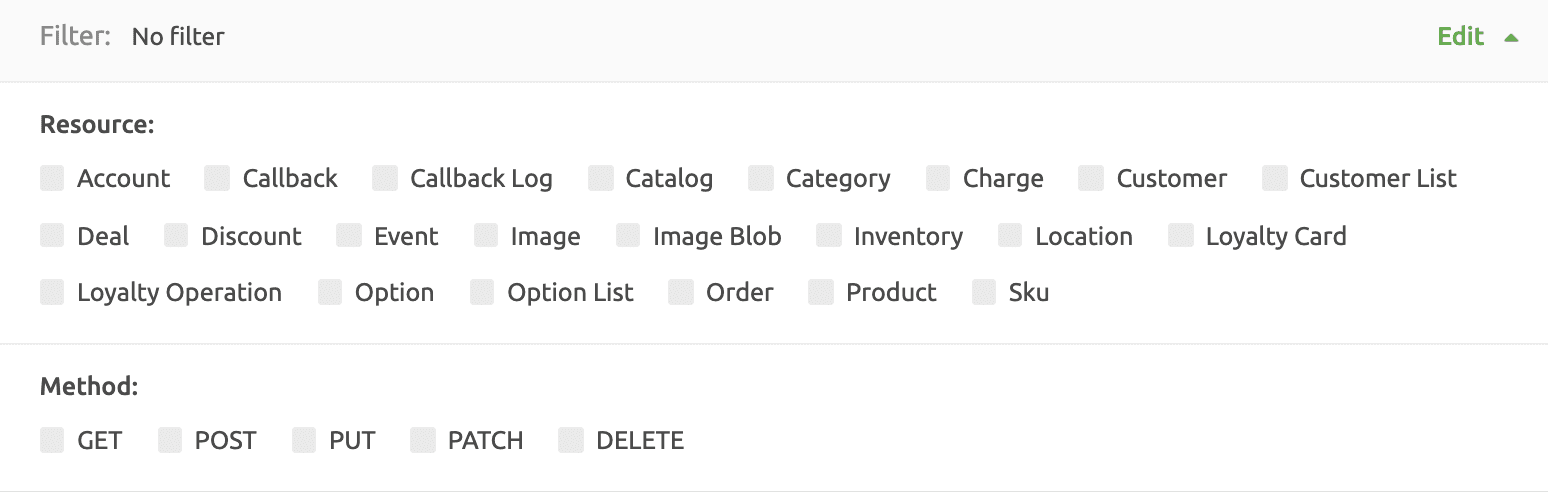
Logs can be filtered by resource and method through the following process:
- Select Edit.
- Select the resources and methods that you want to display. To view all log records, uncheck all resources and methods, or click Reset.
Logs
The logs page displays a summary list of requests in reverse chronological order.
Each log record includes:
- TIME (UTC): The date and time of the request.
- RESOURCE: The target of the request.
- METHOD: The HTTP method used in communicating the request.
- URL: The URL path for the request.
- RESPONSE: The HTTP response code.
You can see additional details by clicking on a log, including the request and the corresponding response.
To download either the request or response, select the download icon  . The selected request or response will be provided as a JSON file.
For more information, see Understanding Logs in HubRise. For a complete reference on the HubRise API, see the HubRise API Reference page.
Related FAQ: How Do I Check If the Connection Between My System and HubRise Is Working?
View Connection Activity
To display a line chart with the number of transactions made in the last 30 days, select CONNECTIONS > Actions > View Activity. This is a handy way to see if transactions are going through the connection.
Related FAQ: How Do I Check If the Connection Between My System and HubRise Is Working?
Rename a Connection
When you connect several instances of the same app to the same HubRise Account or Location, each connection is identified by its name. Each name must be unique, and only one can be left blank.
To change the name of a connection, select CONNECTIONS > Actions > Rename for the specific app, then enter the new name and click Confirm.
Block or Disconnect an App
HubRise allows you to block or disconnect apps:
-
Blocking an app temporarily prevents it from accessing HubRise API. At any time, you can unblock the app to restore access.
-
Disconnecting an app removes the connection between the app and HubRise. The app is notified of the disconnection, which may result in your account being reset or deleted on the app.
IMPORTANT NOTE: If you might use the app again, you should block it rather than disconnect it.
To block or disconnect an app from HubRise, follow these steps:
- Go to CONNECTIONS.
- Find the app you want, then click Actions > Block or Disconnect.
- Click Confirm.
Unblock an App
During the onboarding process, the HubRise support team may block certain apps to prevent them from interfering with your order flow while configuration takes place. You can unblock an app at any time.
To unblock an app, follow these steps:
- Go to CONNECTIONS.
- Find the app you want, then click Actions > Unblock.
Reconnect an App
To switch the catalog or customer list linked to an app, you can use the reconnect feature. This will allow you to select a new catalog or customer list.
This feature is only available for apps with linked catalogs or customer lists.
To reconnect an app, follow these steps:
- Go to CONNECTIONS.
- Find the app you want, then click Actions > Reconnect. This will open the authorisation page in a new browser tab.
- Select the new catalog or customer list, then click Allow.