
“VAT Guesswork”: Why Restaurants Overpay VAT Without Integration
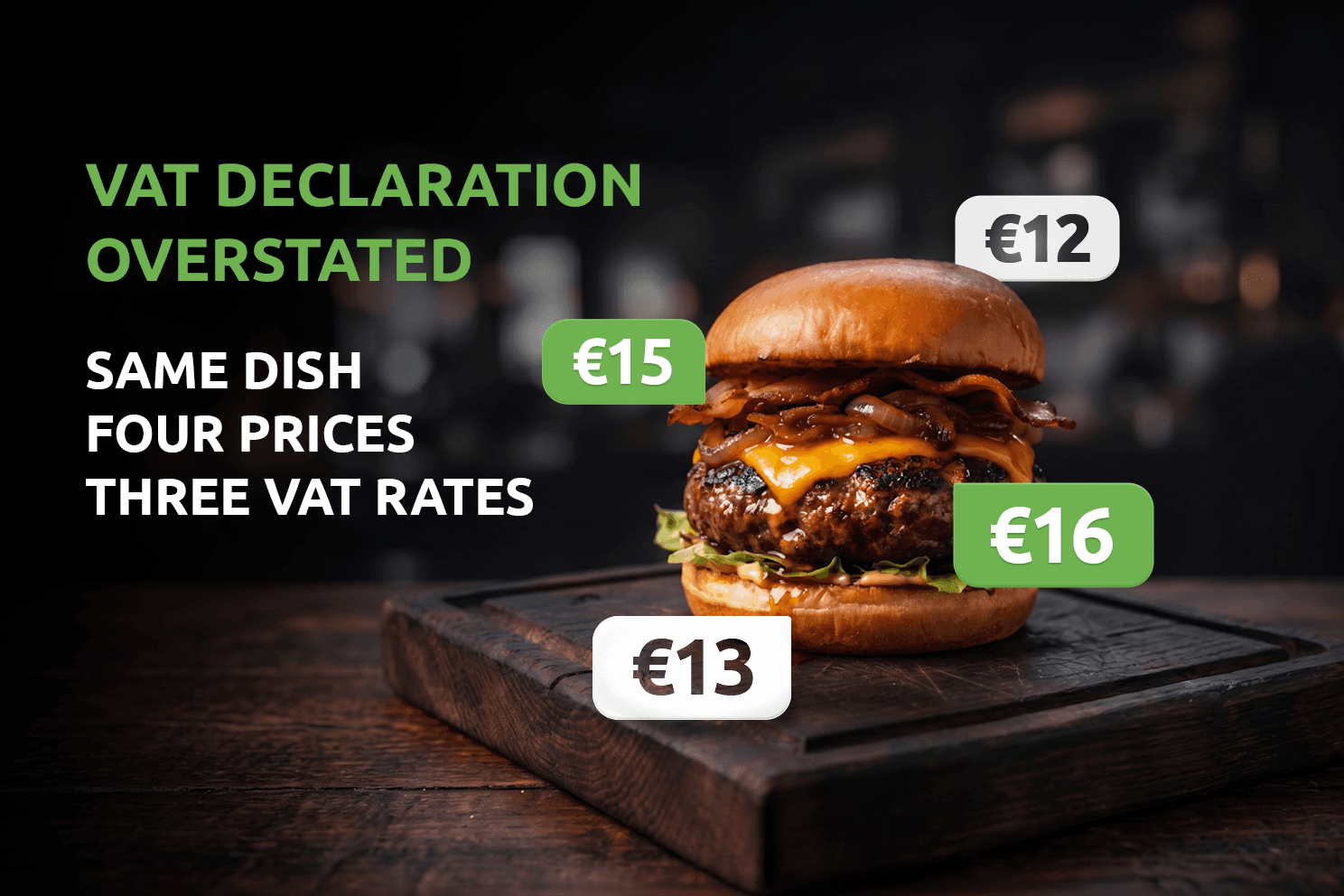
The same burger can have different prices depending on the sales channel. Without integration between delivery platforms and the point of sale, it becomes practically impossible to calculate VAT correctly. Without the right data, the accountant is forced to take a cautious approach and declare more VAT than is actually due. For example, declaring VAT on products that should be zero-rated in the UK, or applying 21% to products that should be taxed at 9% in the Netherlands. Most restaurant owners throughout Europe live with this situation without realising it.
A conversation with an accountant is all it takes to see the problem
When you describe the daily reality of a restaurant owner receiving orders from their website, Uber Eats, Deliveroo and Just Eat, with no integration between those channels and their point of sale, the response from an accountant tends to be pragmatic:
"In principle, it is the restaurant’s responsibility to enter VAT correctly. The accountant simply retrieves the information. In a situation like this, I would tend to apply 10%, while making a cautious estimate of alcohol sales and applying 20% to those. But if the establishment sells a significant amount of alcohol, I would apply a rough 20% to avoid taking any risks and remain compliant." Karine Vigouroux, French accountant, LVK cabinet d'expertise comptable.
That's the reality for the French, stated plainly. For want of anything better, in the Netherlands, a rough 9%, or even 21% when orders include alcoholic drinks may be applied to the differential between the EPOS and the delivery platforms' sales reports.
The problem isn't the accountant. The problem is that we've reached a point where the tools no longer allow a conscientious restaurant owner to do things properly by hand. Integration between sales channels and the point of sale isn’t a convenience feature. It’s what makes accurate VAT calculation possible in practice.
Why VAT in hospitality cannot be handled with a single rate
Before understanding what integration changes, it's worth recalling why a single average rate doesn't work, and why a single receipt can carry different VAT rates under British, Dutch, French or German tax law.
In the UK food service sector, two rates apply:
- 20% on most food products and drinks, whether takeaway, delivery or eat-in.
- 0% on cold takeaway foods, with a number of exceptions.
According to GOV.UK: "Sometimes a single monetary consideration may be the payment for two or more supplies of different liabilities. In such a situation, the business is required to allocate a fair proportion of the total payment to each of the supplies." This requirement is contained in section 19(4) of the VAT Act 1994.
Think about it. How could your accountant even begin to calculate this if the menu items have not been itemised in the EPOS, with the correct price for each item?
The Dutch tax code, similarly, has two separate rates:
- 9% on all food products and non-alcoholic drinks.
- 21% on all alcoholic drinks and non-food items.
The exact same principle applies in Germany, although the rates are different again:
- 7% on all food products.
- 19% on drinks, both alcoholic and non-alcoholic.
How delivery platforms disrupted the system
When sales happen in-store or via a white-label ordering website, the prices displayed on the channel are aligned with those in the point of sale. This is typically the case for stores with an e-commerce website built on Shopify or restaurants with an online ordering website created by LivePepper: if manual entry takes place, it reflects the price actually paid by the customer. The EPOS can then apportion VAT correctly.
With food delivery platforms (Bolt, Deliveroo, Glovo, Just Eat, Uber Eats, Wedely or Wolt), the picture changes completely. To absorb commissions that range between 15% and 30% depending on the plan and can exceed 30% with additional fees, restaurant owners mark up their prices by 15 to 35% on these channels. On top of that:
- meal deals and promotions specific to each delivery platform,
- cancelled or undelivered orders that need to be deducted from revenue,
- delivery platform service fees charged to the customer, which are themselves taxable.
Conclusion. Between the in-store price, the Uber Eats price, the Just Eat price and the amount the restaurant actually receives, there are four different prices for the same burger. And each of those figures carries a different VAT breakdown.
What restaurant owners without integration actually do
Four situations are commonly found, but none is fiscally satisfactory.
1. The EPOS at default prices
This is the most common practice. When an Uber Eats order comes in, the employee enters it into the EPOS with the default in-store prices, not the marked-up prices paid online to Uber Eats. Revenue recorded in the EPOS is lower than what the restaurant actually made. Without the correct prices item-by-item, the accountant cannot calculate VAT accurately and will have to apply a single VAT rate to the gap, which means overpaying VAT.
2. The EPOS with a blanket markup
An alternative practice was observed at an international multi-site chain of local convenience stores: platform orders are entered into the EPOS with a standard markup preconfigured in the software, roughly corresponding to the retained commission. The store owner thinks they're doing the right thing. In reality, this blanket markup creates weekly discrepancies of tens of euros that are impossible to explain. The commission is never exactly constant from one basket to the next, and VAT cannot be correctly apportioned on an average markup calculated by guesswork.
3. The EPOS at real prices
When the EPOS allows it, the employee re-enters the order item by item and manually adjusts the price of each product before recording it, replacing the in-store price with the marked-up price applied on the platform. This method aligns the revenue recorded in the EPOS with the amount actually charged to the customer, but it is time-consuming, cumbersome and fragile. It relies on manual entry, line by line, and assumes that no mistakes are made. In practice, few EPOS systems allow this kind of adjustment, and only restaurant owners receiving few orders can take the time to apply it systematically.
4. No EPOS at all
This is the typical situation for dark kitchens. The restaurant does not invoice the end customer directly, so there is no operational need for a point of sale. To reconstruct VAT, these businesses must manually aggregate the sales reports provided by each platform (when reports are provided in a usable format) and rebuild their own calculation base. The accountant, lacking item-by-item detail, usually has no choice but to apply the highest VAT rate to the total sales declared by the platforms. This is consistent with the tax rules and keeps the restaurant on the safe side, but it is also the most costly for the restaurant.
Impossible reconciliation
A bakery chain with 74 locations in Scotland found itself unable to reconcile its sales and calculate VAT correctly, despite the sustained efforts of its Finance Director.
"Before the integration of delivery platforms with our EPOS, financial reconciliation was simply impossible. Orders were never recorded in the EPOS at the time they arrived. Staff, too busy during peak hours, did the data entry in the evening, sometimes the following day. Item-level discounts were not broken down: a global discount was applied in the EPOS, which makes it mechanically impossible to calculate VAT correctly line by line." Rebecca Hume, Finance Director, Bayne's the Family Bakers.
The final blow: meal deals and promotions
Imagine a platform meal deal in the UK at £18, including sushi at 0% VAT and a beer at 20% VAT. In-store, the same main and drink are sold separately at different prices or as part of a meal deal with the corresponding prices correctly assigned.
For VAT purposes, you cannot simply enter the two items using their unit prices and apply a global discount in the EPOS. The EPOS needs to understand that it's a meal deal, meaning it must split the total £18 price across the two lines while respecting the rate applicable to each.
Doing this by hand, for every order, across three platforms, with promotions changing every week and prices that do not match those on the EPOS, is simply unmanageable. The restaurant owner has two choices. Give up and apply an average rate. Or do it properly and spend their evenings on it. The vast majority choose the first. And some have paid a high price for getting it wrong. This happened recently to a restaurant in Austria that contacted HubRise urgently to connect EPOS Technologies to Foodora after receiving a €7,000 fine.
What integration actually changes
With integration between sales channels and the point of sale, orders are sent directly into the EPOS, with the exact price paid online for each item. This amounts to the very rare scenario in which items are entered at their real prices, but with no manual work: everything is automated. The EPOS can then:
- record each item at its actual selling price on the originating channel,
- apply the calculation rules specific to meal deals and promotions, line by line,
- apportion VAT at the correct rate for each item,
- automatically deduct orders cancelled by the customer or not delivered,
- eliminate all manual data entry and any risk of omission during the rush.
This is precisely the role HubRise plays. It receives the order from the originating channel (Uber Eats, Deliveroo, Just Eat, white-label online ordering website, mobile app, kiosk), preserves the complete transactional data (item lines, prices paid line by line, deals, promotions, order status) and transmits it to the point of sale in the format it expects.
For the restaurant owner, this guarantees that the tax data reaches the end of the chain intact, regardless of the combination of sales channels and EPOS system being used.
With no gap between accounting records, platform reports and bank statements, the accountant can rely on the VAT calculations provided by the EPOS when preparing the VAT return. No need to estimate or to fall back on the higher VAT rate as a safety measure. The data is there, at the right level of detail, ready to be exported and given to the accountant.
In the event of a tax audit, the restaurant owner can demonstrate good faith through the automation of the process. Every order is traceable, every line is correctly allocated, and every VAT rate applied is documented. That carries weight.
And as an added benefit, this removes a manual data-entry task, one of the most tedious administrative jobs there is, while, above all, avoiding any flat-rate VAT uplift that would otherwise have to be applied as a precaution.
A related problem: reconciling platform invoices
VAT is just one dimension of the problem. The other is reconciliation between the EPOS and the invoices sent by the delivery platforms every week or fortnight.
A Just Eat invoice, for example, shows:
- total sales (VAT included),
- number of orders,
- the amount the platform will pay the restaurant (total sales minus commission),
- the Just Eat commission (calculated on the total VAT-inclusive amount, on a VAT the restaurant never actually receives),
- the VAT applied to the commission itself,
- orders deducted for cancellation or non-delivery.
Without integration, the restaurant owner or their accountant has to reconcile this invoice against the restaurant’s own EPOS data, data which, as we have seen, is already incomplete or distorted. Consolidation then becomes a monthly forensic exercise that often does little more than reveal discrepancies that cannot be explained.
With an EPOS system integrated through HubRise as the backbone, every platform order is tracked with its exact price, VAT breakdown and status (delivered, cancelled or refunded). The restaurant owner has access to sales reports by channel, which can be exported and used by the accounting firm. When it comes to reconciling invoices, the figures match. The accountant no longer needs to patch things together, make assumptions or, above all, increase the VAT declared as a precaution.
What's at stake
Integration is not simply about getting orders into the EPOS without manual re-entry. It is a practical prerequisite for complying with VAT apportionment rules in restaurants operating across multiple sales channels.
"Without integration, the restaurant owner is caught between three options: overpaying VAT as a precaution, under-declaring VAT by default and risking a tax reassessment, or spending an unreasonable amount of time on item-by-item work that should be automated. With integration, every item is recorded at its actual selling price. Every VAT rate is applied at the correct level. Every cancelled order is deducted. And the accountant can do their job without having to resort to rough estimates." — Janaina Wittner, Partner Manager, HubRise.
This conclusion emerged from HubRise’s discussions with numerous restaurant owners, retailers, established restaurant chains, EPOS software providers and accountants.
Have questions about this blog post?
Whether you're looking for more details about this article or want to find out how HubRise can help your business, we're here for you.