
Uber Eats Bridge
- home
- Apps
- Uber Eats Bridge
- User Interface

User Interface
From Uber Eats Bridge, you can read the logs of all the operations between HubRise and Uber Eats, and access the configuration settings of the integration.
Latest Operations
This is the default page when you open Uber Eats bridge. It displays the latest API operations between HubRise, Uber Eats, and Uber Eats Bridge.
Operations can either be related to a specific order, or be generic system requests performed by Uber Eats Bridge.
Each row in the page shows the following information about an operation:
- TIME: The date and time of the order.
- ORDER: The HubRise order ID, for order operations.
- DESCRIPTION: An optional description for operations that are not related to a specific order. It could be empty, or inform of a specific action such as
System requestorCatalog push. - STATUS: The status of the order. The value
OKindicates that the order has been successfully sent, otherwise an error code will be displayed in red.
The "System request" label indicates that the operation is not related to a specific order.
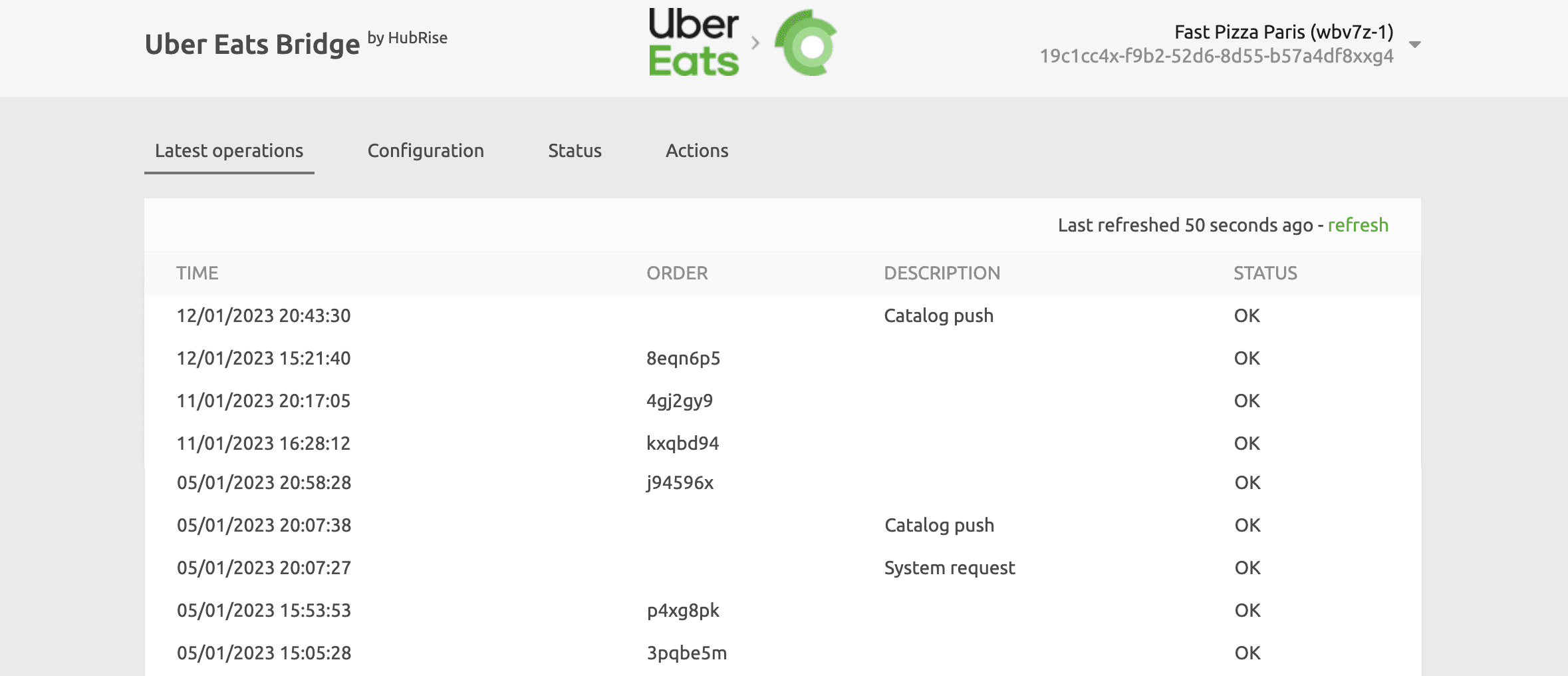
Clicking on a row will open a new page displaying the logs associated with the operation.
Order Operation
Selecting an order operation from the list in the main page will display all the logs of the API requests exchanged between HubRise and Uber Eats via Uber Eats Bridge.
Requests are ordered with the latest on top, and those related to the same order event (order received, order cancelled, etc.) are visually grouped together.
Each row in the logs displays the following information:
- Time: The date and time the request was sent.
- Direction: The apps sending and receiving the request, in the format Origin → Destination.
- Endpoint: The status of the request. The value
OKindicates that the request has been successfully received, otherwise a message will explain the type of error occurred.
Clicking on a request will expand it to reveal the detailed logs of the request and its response.
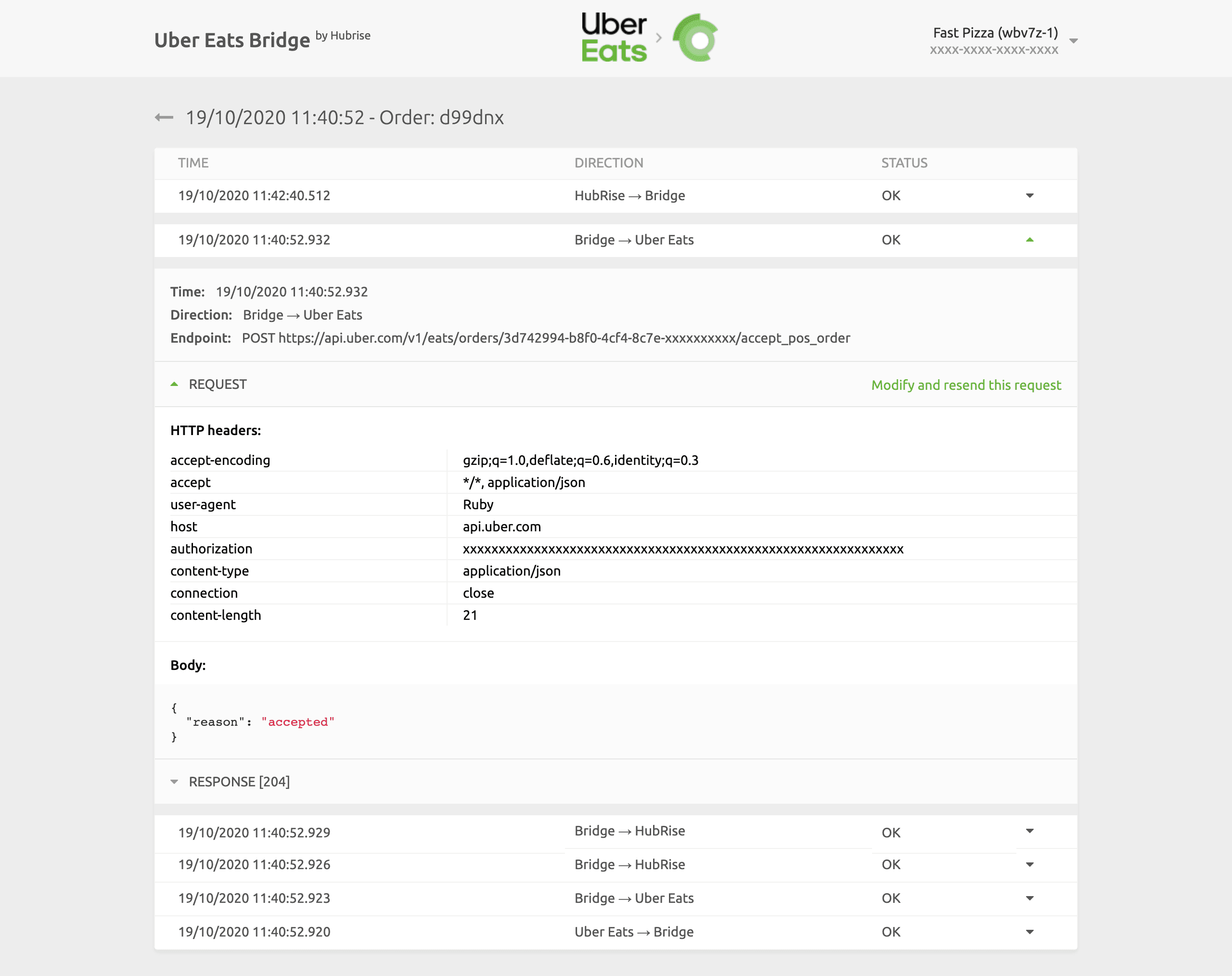
Logs are a powerful debugging tool in case of issues. To understand in detail how to read logs, see Understanding HubRise Logs.
System Request Operation
The layout of a system request page is identical to that of an order page.
System requests are generally sent by Uber Eats Bridge to notify HubRise about a change in the configuration or to fetch the most up-to-date information. As an example, the following image displays a request to update the Uber Eats Bridge callback after a configuration change.
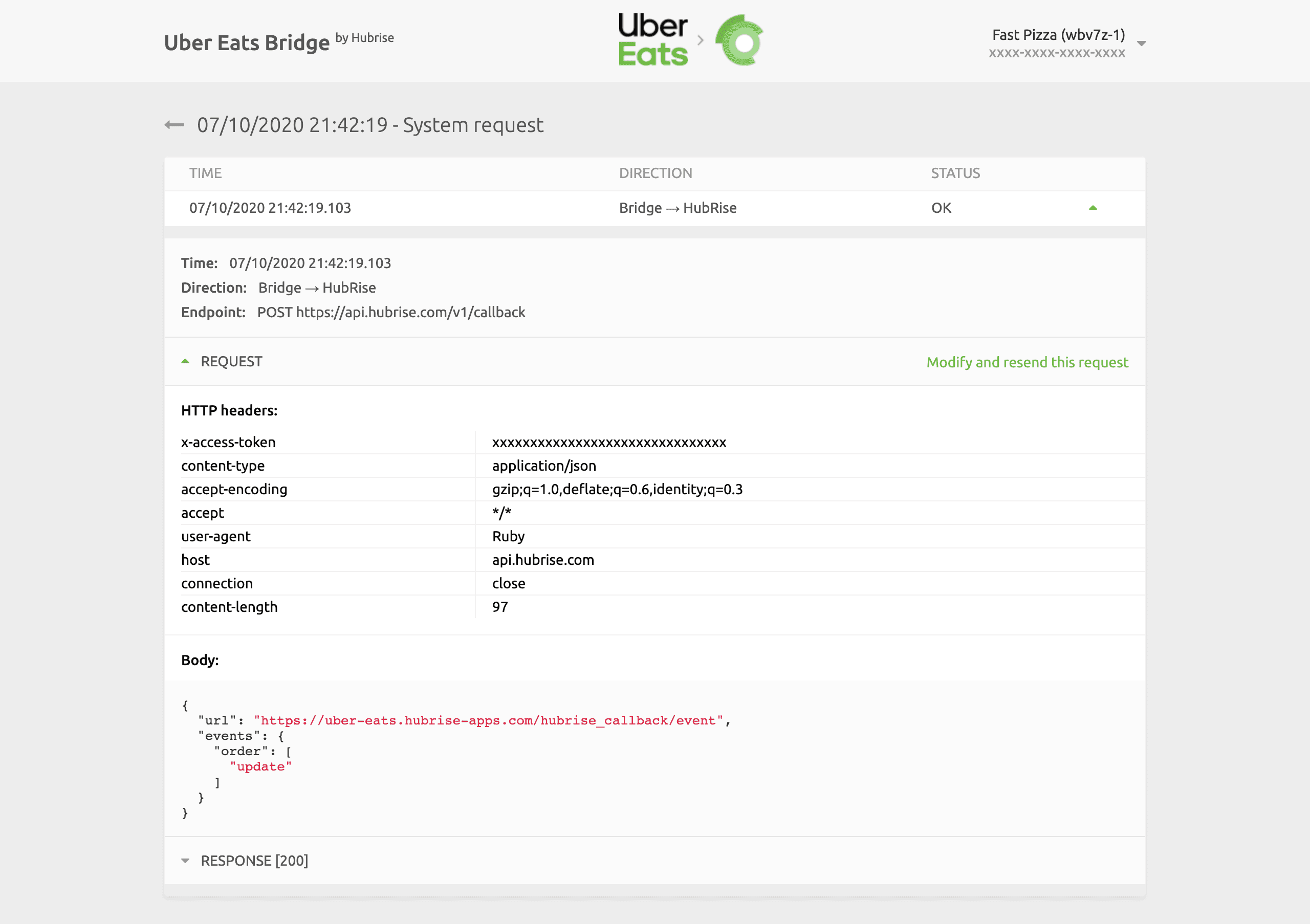
System request pages can provide useful debugging insights to support teams, but are rarely of interest to other users.
Configuration
To access the Uber Eats Bridge configuration page, click Configuration at the top of the screen.
From this page, you will be able to customise the behaviour of Uber Eats Bridge. For more details, see Configuration.
Status
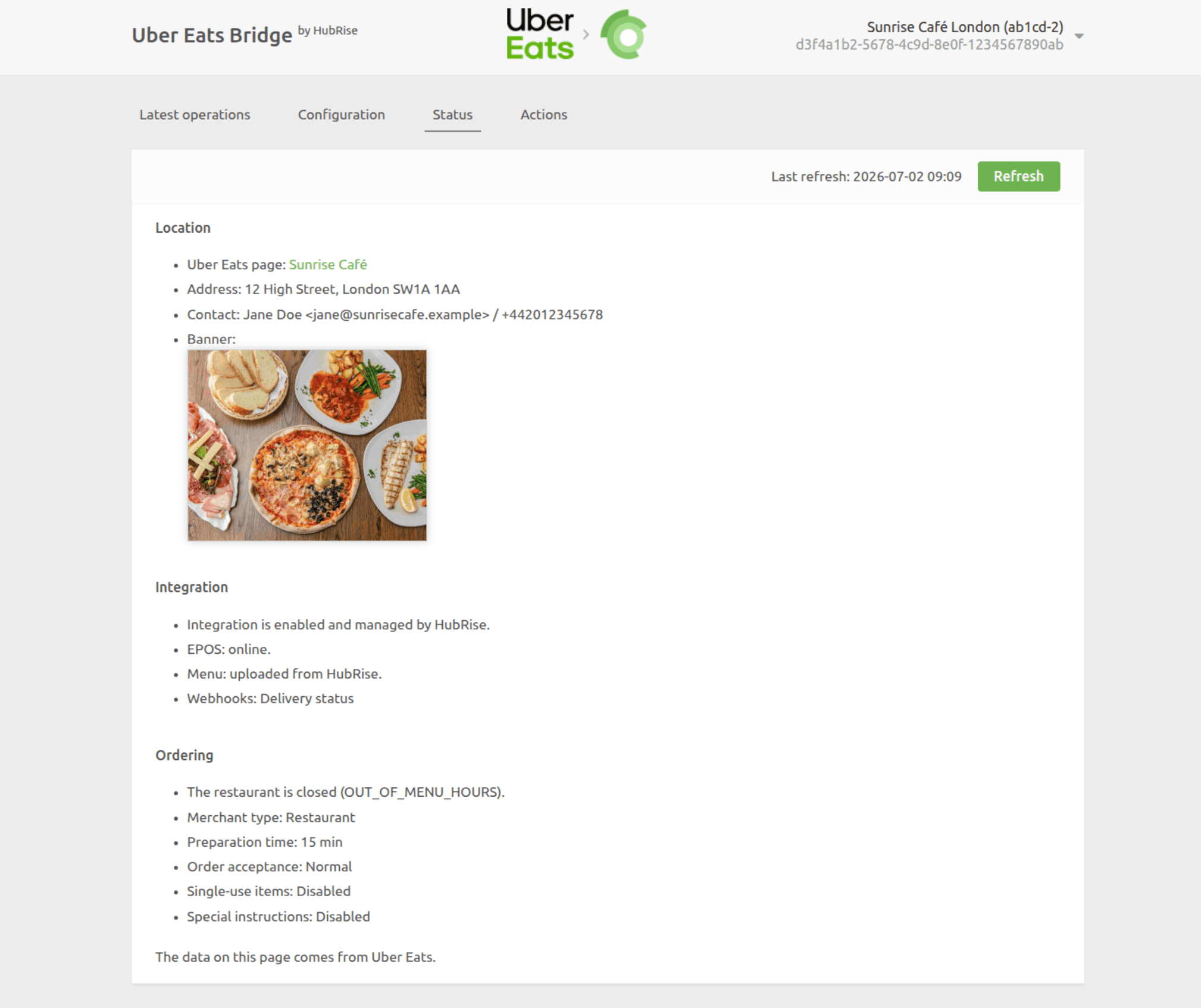
The information available on the Status page is pulled from the Uber Eats API. It shows the configuration of the integration on Uber Eats' side.
To view the current status, you need to refresh the page by clicking Refresh, in the top right corner. The Last refresh date will update when the information is retrieved.
The Location section identifies the Uber Eats store connected to Uber Eats Bridge:
- Uber Eats page: A link to the store's page on the Uber Eats website.
- Address: The store's postal address.
- Contact: The store contact's name, email, and phone number.
- Banner: The banner image displayed on the Uber Eats website.
The Integration section shows how the integration is set up on Uber Eats' side:
- Status: Whether the HubRise integration is enabled, and whether it is managed by HubRise or by another system.
- EPOS: Whether HubRise, which Uber Eats treats as an EPOS, is online. Should always be "online".
- Menu: Whether a menu has been uploaded from HubRise. HubRise updates only one menu per restaurant, so a warning is shown if Uber Eats has more than one.
- Webhooks: The webhooks enabled on Uber Eats. In most setups, only the Delivery status webhook should be enabled, and a warning is shown otherwise.
The Ordering section reflects the restaurant's current ordering settings:
- Availability: Whether the restaurant is open or closed at the time of the refresh.
- Merchant type: The type of merchant.
- Preparation time: The default preparation time.
- Order acceptance: Normal, Busy or Very busy. When the restaurant is Busy or Very busy, the extra preparation time applied and the time at which the delay ends are also shown.
- Single-use items: Whether customers can request single-use items, such as utensils and napkins.
- Special instructions: Whether customers can add special instructions to their order.
Actions
To access the actions page, click Actions at the top of the screen. If the link is not visible, first complete the configuration of Uber Eats Bridge.
From the actions page, you can perform the following actions:
- Push Catalog: Push the catalog to Uber Eats. For more details, see Push Catalog.
- Pull Catalog: Pull the catalog from Uber Eats. For more details, see Pull Catalog.
- Pull Opening Hours: Replace your HubRise opening hours with the hours of your Uber Eats menus. When your store has several menus, the hours of all menus are combined. The cutoff time is set to a time of the day at which your store is closed on every day of the week, so that hours crossing midnight are not split in two. Nothing is updated if Uber Eats returns no opening hours for your store.
- Push Inventory: Push your HubRise inventory to Uber Eats.
Language and Navigation
In the top right corner of the screen, you can click on the arrow  to expand the menu. From there, you can change the language of the page to English or French.
Clicking on the Uber Eats and HubRise logos on top of any page of Uber Eats Bridge will bring you back to the Latest Operations page.